

Close Menu
Terrain News
  • Environmental Science
  • Landforms & Habitats
  • Extreme Events
  • Watershed Restoration
  • Wildfire
What's Hot

Colorado Bill Aims to Safeguard Beavers and Mitigate Wildfire and Drought Threats

Stormwater Management Challenges Threaten Watershed Restoration

Restoring Nature’s Gems: CERC’s Mussel Conservation in the Clinton Watershed

Facebook X (Twitter) Instagram
Facebook X (Twitter) Instagram Pinterest
Terrain News
TerrainWorks
  • Environmental Science
  • Landforms & Habitats
  • Extreme Events
  • Watershed Restoration
  • Wildfire
Terrain News
You are at:Home»Watershed & Environmental Science»Mapping Alpine Snow Depth and Volume Using Aerial Imagery Techniques
Watershed & Environmental Science

Mapping Alpine Snow Depth and Volume Using Aerial Imagery Techniques

Terrain NewsBy Terrain NewsApril 2, 2025002 Mins Read
Share Facebook Twitter Pinterest LinkedIn Tumblr Email
Mapping Alpine Snow Depth And Volume Using Aerial Imagery Techniques
Share
Facebook Twitter LinkedIn Pinterest Email

In mountainous environments, traditional methods for measuring snow depth and snow water equivalent often fall short due to limited spatial coverage, especially in high elevations and remote areas. This article discusses the use of Structure from Motion (SfM) photogrammetry as an innovative approach to enhance snow depth mapping by utilizing images captured from aircraft. It highlights successes from the Airborne Snow Observatory (ASO), which combines lidar data and imaging spectrometry for accurate snow measurements.

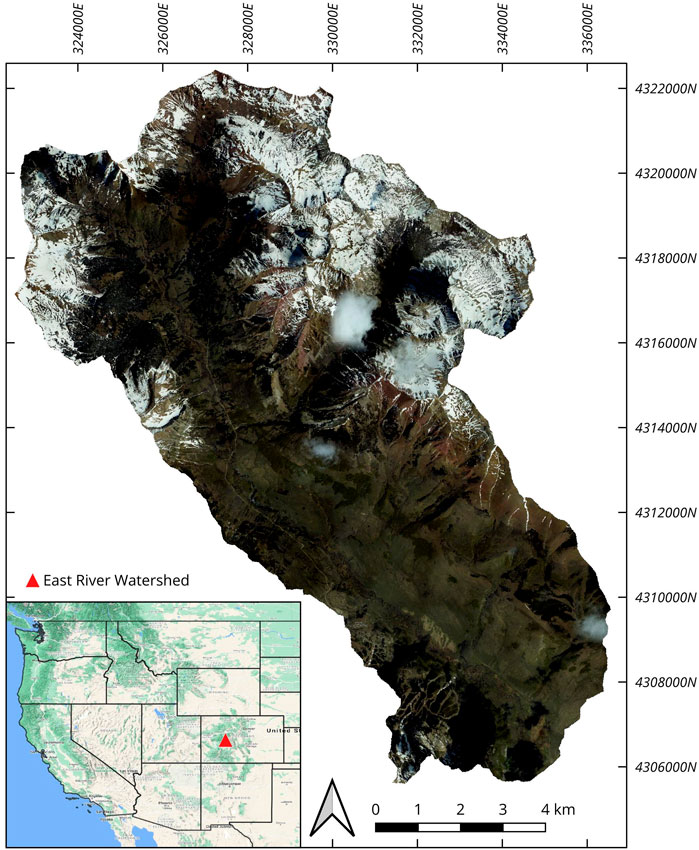
The study focuses on evaluating SfM’s ability to estimate snow depths using high-resolution RGB photographs in comparison to established lidar-based methods. Conducted over the East River Watershed in Colorado, the analysis involved capturing snow-on and snow-free imagery, alongside lidar data for ground truthing. The results indicated that while SfM can capture snow depth effectively in open areas, challenges remain in regions with vegetation and steep slopes. Nonetheless, the SfM technique achieved promising accuracy, comparing favorably to lidar outputs with a relatively low normalized median absolute difference.

Overall, the findings suggest that SfM could serve as a supplementary method for large-scale snow observation, particularly where lidar is not feasible. The technique shows potential for continuous snow depth monitoring and can aid in hydrological modeling, offering a scalable solution for water resource management in mountainous catchments. Future research may focus on expanding the use of SfM across different terrains and conditions to refine its efficacy and integration into operational frameworks.

Source link

Aerial Alpine Depth Imagery Mapping Snow Techniques Volume
Share. Facebook Twitter Pinterest LinkedIn Tumblr Email
Previous ArticleAddressing the Ripple Effects of Extreme Weather and Climate Change: Insights from the Multi-Hazard Early Warning Conference
Next Article Innovative Sandbox Technology Enhances Wildfire Training for Colorado Firefighters
leebenda
Terrain News
  • Website

Related Posts

Restoring Nature’s Gems: CERC’s Mussel Conservation in the Clinton Watershed

March 5, 2026

Impact of Forest Development on Water Quality in the Middle Chattahoochee Watershed

March 4, 2026

Great Lakes Watershed Science Unleashed

March 3, 2026
Top Posts

Steamboat Secures $5 Million for River Revitalization

January 25, 202520 Views

Harnessing Machine Learning to Enhance Extreme Weather Alerts

January 8, 202519 Views

Boosting Carbon Storage: Maximizing Terrestrial Vegetation through Smart Land Management

February 1, 202516 Views
Stay In Touch
  • Facebook
  • YouTube
  • TikTok
  • WhatsApp
  • Twitter
  • Instagram
Most Popular

Steamboat Secures $5 Million for River Revitalization

January 25, 202520 Views

Harnessing Machine Learning to Enhance Extreme Weather Alerts

January 8, 202519 Views

Boosting Carbon Storage: Maximizing Terrestrial Vegetation through Smart Land Management

February 1, 202516 Views
Don't Miss

Colorado Bill Aims to Safeguard Beavers and Mitigate Wildfire and Drought Threats

Stormwater Management Challenges Threaten Watershed Restoration

Restoring Nature’s Gems: CERC’s Mussel Conservation in the Clinton Watershed

Popular This Week

Enhancing Snowpack and Wildfire Resilience Through Selective Forest Thinning in the Eastern Cascades

Stormwater Management Challenges Threaten Watershed Restoration

Impact of Forest Development on Water Quality in the Middle Chattahoochee Watershed

© 2026 Terrain News. All Rights Reserved.
  • About Us
  • Privacy Policy
  • Terms and Conditions
  • Disclaimer

Type above and press Enter to search. Press Esc to cancel.