

Close Menu
Terrain News
  • Environmental Science
  • Landforms & Habitats
  • Extreme Events
  • Watershed Restoration
  • Wildfire
What's Hot

Lawmaker Aims to Secure Permanent Funding for Wildfire Air Support Program

Give Your Christmas Tree a Second Life for Credit River Restoration

Wyoming’s Wildfires Devastate 250,000 Acres in 2025

Facebook X (Twitter) Instagram
Facebook X (Twitter) Instagram Pinterest
Terrain News
TerrainWorks
  • Environmental Science
  • Landforms & Habitats
  • Extreme Events
  • Watershed Restoration
  • Wildfire
Terrain News
You are at:Home»Landforms, Processes & Habitats»Boosting Carbon Storage: Maximizing Terrestrial Vegetation through Smart Land Management
Landforms, Processes & Habitats

Boosting Carbon Storage: Maximizing Terrestrial Vegetation through Smart Land Management

Terrain NewsBy Terrain NewsFebruary 1, 20250122 Mins Read
Share Facebook Twitter Pinterest LinkedIn Tumblr Email
Boosting Carbon Storage: Maximizing Terrestrial Vegetation Through Smart Land Management
Share
Facebook Twitter LinkedIn Pinterest Email

The article categorizes factors affecting vegetation carbon sequestration into three main areas: climate impacts (mainly precipitation and temperature), other environmental factors (such as landforms, vegetation types, and soil properties), and human-related land management practices. It explains that when the influences of climate and environmental factors are removed, variations in carbon sequestration can be attributed solely to human impact.

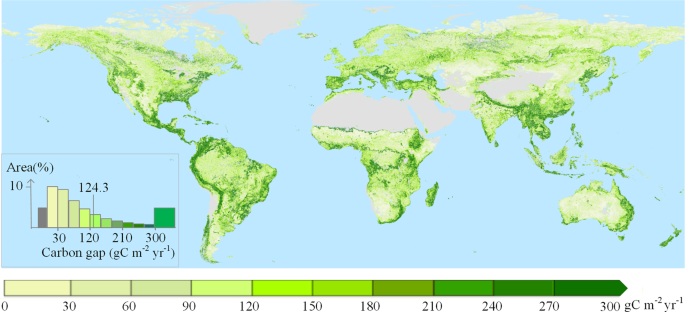
Using net primary productivity (NPP) as a measure of carbon sequestration capacity, the study employs models to analyze the interaction between climate and human practices. It introduces the concept of climate-rectified NPP (NPPCR) to isolate human impacts on NPP variation. The objective is to identify potential increases in carbon sequestration (referred to as the carbon gap) achievable through better land management without changing land use or vegetation biomes.

Data is processed using publicly available datasets, focusing on segments of homogeneous environmental zones, and uses statistical methods to quantify the carbon gap. The analysis reveals significant potential for enhanced carbon sequestration—estimated at an increase of 13.74 PgC per year—with human land management practices being the key to achieving this goal.

The study also validates its findings with data from grasslands in Inner Mongolia, highlighting the positive impacts of optimal land management practices on vegetation productivity and carbon sequestration. Overall, the research underscores the critical role humans can play in maximizing carbon sequestration through informed land management strategies.

Source link

Boosting Carbon Land Management Maximizing Smart Storage Terrestrial Vegetation
Share. Facebook Twitter Pinterest LinkedIn Tumblr Email
Previous ArticleIndia’s Relentless Struggles: A Year of Daily Disasters
Next Article Enhancing Ecosystem Health: A Bioassessment Framework for the Upper Tana River Watershed
leebenda
Terrain News
  • Website

Related Posts

Innovative Approaches in Natural Resource Management

December 27, 2025

Beyond Limits in Louisiana Watershed Management

December 19, 2025

Temporary Closures at Rend Lake for Firearm Deer Season Inspection

December 19, 2025
Top Posts

Steamboat Secures $5 Million for River Revitalization

January 25, 202520 Views

Harnessing Machine Learning to Enhance Extreme Weather Alerts

January 8, 202519 Views

Understanding Extreme Weather: The Link to the Climate Crisis

January 8, 202515 Views
Stay In Touch
  • Facebook
  • YouTube
  • TikTok
  • WhatsApp
  • Twitter
  • Instagram
Most Popular

Steamboat Secures $5 Million for River Revitalization

January 25, 202520 Views

Harnessing Machine Learning to Enhance Extreme Weather Alerts

January 8, 202519 Views

Understanding Extreme Weather: The Link to the Climate Crisis

January 8, 202515 Views
Don't Miss

Lawmaker Aims to Secure Permanent Funding for Wildfire Air Support Program

Give Your Christmas Tree a Second Life for Credit River Restoration

Wyoming’s Wildfires Devastate 250,000 Acres in 2025

Popular This Week

Maili Wildfire Update: 75% Contained After Impacting 95 Acres

Watershed Specialist Discusses Stream Restoration Challenges in the Area

Lawmaker Aims to Secure Permanent Funding for Wildfire Air Support Program

© 2025 Terrain News. All Rights Reserved.
  • About Us
  • Privacy Policy
  • Terms and Conditions
  • Disclaimer

Type above and press Enter to search. Press Esc to cancel.