
Close Menu
Terrain News
  • Environmental Science
  • Landforms & Habitats
  • Extreme Events
  • Watershed Restoration
  • Wildfire
What's Hot

Hazy Skies Persist as Heat Lingers with a Humidity Break

Water Quality Concerns Unveiled in Cannon River Watershed

Latest Insights on Wildfire Conditions in BWCA and Superior National Forest

Facebook X (Twitter) Instagram
Facebook X (Twitter) Instagram Pinterest
Terrain News
TerrainWorks
  • Environmental Science
  • Landforms & Habitats
  • Extreme Events
  • Watershed Restoration
  • Wildfire
Terrain News
You are at:Home»Extreme Climate & Geophysical Events»Climate Shifts in Southeastern Oromia: Analyzing Extreme Rainfall and Temperature Trends
Extreme Climate & Geophysical Events

Climate Shifts in Southeastern Oromia: Analyzing Extreme Rainfall and Temperature Trends

Terrain NewsBy Terrain NewsAugust 15, 2025092 Mins Read
Share Facebook Twitter Pinterest LinkedIn Tumblr Email
Climate Shifts In Southeastern Oromia: Analyzing Extreme Rainfall And Temperature
Share
Facebook Twitter LinkedIn Pinterest Email

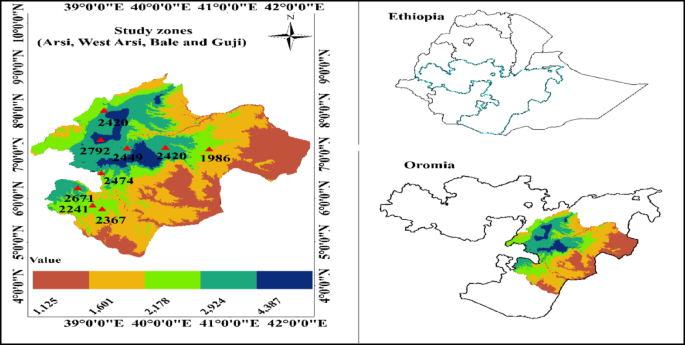
The article analyzes the descriptive statistics of agroclimatic extremes related to rainfall and temperature across nine meteorological stations in southeastern Oromia, Ethiopia, over a 30-year period (1994-2023).

Key Findings:

  1. Precipitation Extremes:

    • Consecutive Dry Days (CDD): Average of 52 days/year with significant variation among stations. Areas such as Ginir and Asela exhibit higher CDD (58-61 days), while Bore has fewer (44-46 days). Variability attributed to topography and climate change.
    • Consecutive Wet Days (CWD): Average of 16 days/year, with fluctuations noted; Agarfa showed the minimum and Bokoji the maximum.
    • Rainfall Intensity (SDII): Average of 7.1 mm/day/year with considerable variability. Highest recorded at Adola (9.0 mm) and lowest at Sinana (5.3 mm).
    • Heavy Rainfall Days: Average of 27 days/year for precipitation exceeding 10 mm, varying greatly by region (17 at Sinana to 40 at Bore).
  2. Temperature Extremes:

    • Cool Nights (TN10P): Average of 11% (~40 days/year) indicating low variability. Areas like Adola had fewer cool nights.
    • Warm Nights (TN90P): Average of 10.9% with consistent upward trends; districts like Ginir and Dodola showed positive trends.
    • Daily Maximum Temperature (TXx): What appears to be a warming trend, with notable increases across most stations.
  3. Temporal Trends:

    • Overall, 33.3% of stations showed increasing trends in total wet-day rainfall (PRCPTOT), with some stations experiencing significant decreases, indicating rising water security challenges. Mixed trends exist for very wet days (R95P and R99P) across different stations, suggesting divergent local climatic influences.
    • Extreme Temperature Trends: Nearly all stations indicate a warming trend, particularly for warm day and night indicators, contrasting with declines in cool temperature metrics.
  4. Conclusions:
    • A complex interaction between local climate variability, topography, and meteorological patterns impacts farming, water management, and regional planning.
    • The results underscore the necessity for localized adaptation strategies to mitigate the adverse effects of these climatic changes on agriculture and ecosystems.

This comprehensive analysis highlights the urgent need for attention to climate impacts in southeastern Oromia amid evolving agroclimatic conditions.

Source link

Analyzing Climate Extreme Oromia Rainfall Shifts Southeastern Temperature Trends
Share. Facebook Twitter Pinterest LinkedIn Tumblr Email
Previous ArticleReviving the Paulins Kill River
Next Article Surveying Community Insights for Runyon Creek Restoration Plan
leebenda
Terrain News
  • Website

Related Posts

Disasters Redefined: A Look at 21st Century Challenges

July 6, 2026

Understanding the Challenges of the New El Niño Cycle

July 5, 2026

Global Readiness for Climate-Driven Disasters Needs Urgent Attention

June 29, 2026
Top Posts

Steamboat Secures $5 Million for River Revitalization

January 25, 202522 Views

Harnessing Machine Learning to Enhance Extreme Weather Alerts

January 8, 202519 Views

Assessing Climate Change and Human Influence on Runoff in a South China Tropical Watershed

February 3, 202518 Views
Stay In Touch
  • Facebook
  • YouTube
  • TikTok
  • WhatsApp
  • Twitter
  • Instagram
Most Popular

Steamboat Secures $5 Million for River Revitalization

January 25, 202522 Views

Harnessing Machine Learning to Enhance Extreme Weather Alerts

January 8, 202519 Views

Assessing Climate Change and Human Influence on Runoff in a South China Tropical Watershed

February 3, 202518 Views
Don't Miss

Hazy Skies Persist as Heat Lingers with a Humidity Break

Water Quality Concerns Unveiled in Cannon River Watershed

Latest Insights on Wildfire Conditions in BWCA and Superior National Forest

Popular This Week

Latest Insights on Wildfire Conditions in BWCA and Superior National Forest

Wissahickon Valley Watershed Association Appoints Gail Farmer as Executive Director

Mexico Boosts Forest Restoration Efforts Nationwide

© 2026 Terrain News. All Rights Reserved.
  • About Us
  • Privacy Policy
  • Terms and Conditions
  • Disclaimer

Type above and press Enter to search. Press Esc to cancel.