

Close Menu
Terrain News
  • Environmental Science
  • Landforms & Habitats
  • Extreme Events
  • Watershed Restoration
  • Wildfire
What's Hot

Enhanced Watershed Management: Prioritizing Kiltie Micro-Watershed in Ethiopia Through Morphometric Analysis and Weighted Sum Techniques

Innovative Solutions for Client Success

St. Croix Watershed Research Station Launches Summer 2018 Artist and Writer Residencies

Facebook X (Twitter) Instagram
Facebook X (Twitter) Instagram Pinterest
Terrain News
TerrainWorks
  • Environmental Science
  • Landforms & Habitats
  • Extreme Events
  • Watershed Restoration
  • Wildfire
Terrain News
You are at:Home»Extreme Climate & Geophysical Events»Global Risk Assessment of Natural Disasters 2010
Extreme Climate & Geophysical Events

Global Risk Assessment of Natural Disasters 2010

Terrain NewsBy Terrain NewsMay 1, 2025061 Min Read
Share Facebook Twitter Pinterest LinkedIn Tumblr Email
Global Risk Assessment Of Natural Disasters 2010
Share
Facebook Twitter LinkedIn Pinterest Email

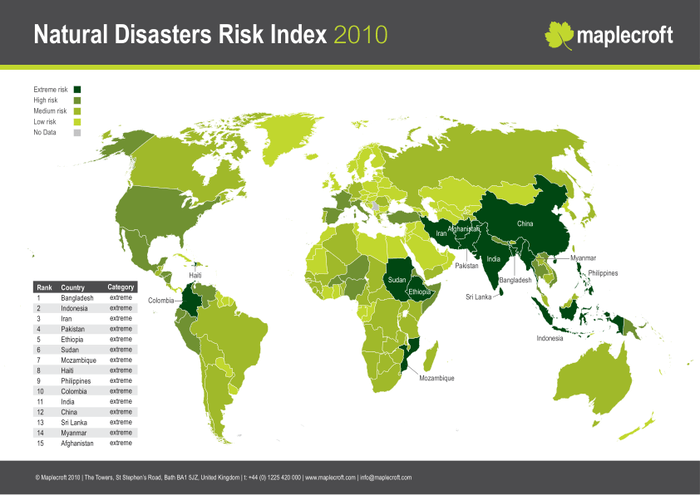
A new study by Maplecroft ranks 229 countries based on their vulnerability to natural disasters, with Bangladesh, Indonesia, and Iran identified as the most at risk. The Natural Disasters Risk Index (NDRI) assesses human impact from disasters—deaths per year and event frequency over 30 years—covering various incidents like earthquakes and storms. Fifteen countries, including Pakistan and Ethiopia, are categorized as “extreme risk.”

Poverty, poor infrastructure, and overcrowding exacerbate vulnerability. Bangladesh has suffered 191,637 disaster-related deaths, primarily from storms, while Indonesia’s casualties largely stemmed from the 2004 tsunami. Iran faces seismic threats, accounting for significant fatalities. India and China also report heavy losses due to diverse disaster types.

The report emphasizes that climate change may increase such events, urging even wealthy nations to enhance disaster risk reduction. Among G8 countries, France and Italy are notably high-risk in Europe. In contrast, the UK is considered “low risk.” The NDRI leverages data from multiple reputable sources to analyze global disaster risks.

Source link

Assessment Disasters Global Natural Risk
Share. Facebook Twitter Pinterest LinkedIn Tumblr Email
Previous ArticleRestoring the West Maui Watershed: Inspiring Native Hawaiian Youth
Next Article City and County Leaders Launch Wildfire Awareness Month
leebenda
Terrain News
  • Website

Related Posts

Cairngorms Wildfire Risk Rises Amid Weather Changes, Police Issue Major Incident Alert

July 24, 2026

Reducing Wildfire Risk: 212 Acres Treated in Deschutes National Forest Near Two Rivers North

July 9, 2026

Disasters Redefined: A Look at 21st Century Challenges

July 6, 2026
Top Posts

Steamboat Secures $5 Million for River Revitalization

January 25, 202523 Views

Assessing Climate Change and Human Influence on Runoff in a South China Tropical Watershed

February 3, 202519 Views

Harnessing Machine Learning to Enhance Extreme Weather Alerts

January 8, 202519 Views
Stay In Touch
  • Facebook
  • YouTube
  • TikTok
  • WhatsApp
  • Twitter
  • Instagram
Most Popular

Steamboat Secures $5 Million for River Revitalization

January 25, 202523 Views

Assessing Climate Change and Human Influence on Runoff in a South China Tropical Watershed

February 3, 202519 Views

Harnessing Machine Learning to Enhance Extreme Weather Alerts

January 8, 202519 Views
Don't Miss

Enhanced Watershed Management: Prioritizing Kiltie Micro-Watershed in Ethiopia Through Morphometric Analysis and Weighted Sum Techniques

Innovative Solutions for Client Success

St. Croix Watershed Research Station Launches Summer 2018 Artist and Writer Residencies

Popular This Week

Rain Barrels: A Sustainable Solution for Water Conservation

Join the 2026-27 AmeriCorps Watershed Ambassadors Program with DEP

Chesapeake Bay Report: Watershed Earns C Grade

© 2026 Terrain News. All Rights Reserved.
  • About Us
  • Privacy Policy
  • Terms and Conditions
  • Disclaimer

Type above and press Enter to search. Press Esc to cancel.