
Close Menu
Terrain News
  • Environmental Science
  • Landforms & Habitats
  • Extreme Events
  • Watershed Restoration
  • Wildfire
What's Hot

Volunteers Transform Prairie Day at Jennings Environmental Education Center into a Success

$6.5 Million Secured for Wildlife Habitat Restoration in 2026 Conservation Permits

Hydrologic Insights from Conductive Topsoils in Ecuador’s Alpine Catchment

Facebook X (Twitter) Instagram
Facebook X (Twitter) Instagram Pinterest
Terrain News
TerrainWorks
  • Environmental Science
  • Landforms & Habitats
  • Extreme Events
  • Watershed Restoration
  • Wildfire
Terrain News
You are at:Home»Watershed & Environmental Science»Heavy Metal Pollution in the Sediments of Awetu Watershed, Southwestern Ethiopia
Watershed & Environmental Science

Heavy Metal Pollution in the Sediments of Awetu Watershed, Southwestern Ethiopia

Terrain NewsBy Terrain NewsMarch 20, 2025062 Mins Read
Share Facebook Twitter Pinterest LinkedIn Tumblr Email
Heavy Metal Pollution In The Sediments Of Awetu Watershed, Southwestern
Share
Facebook Twitter LinkedIn Pinterest Email

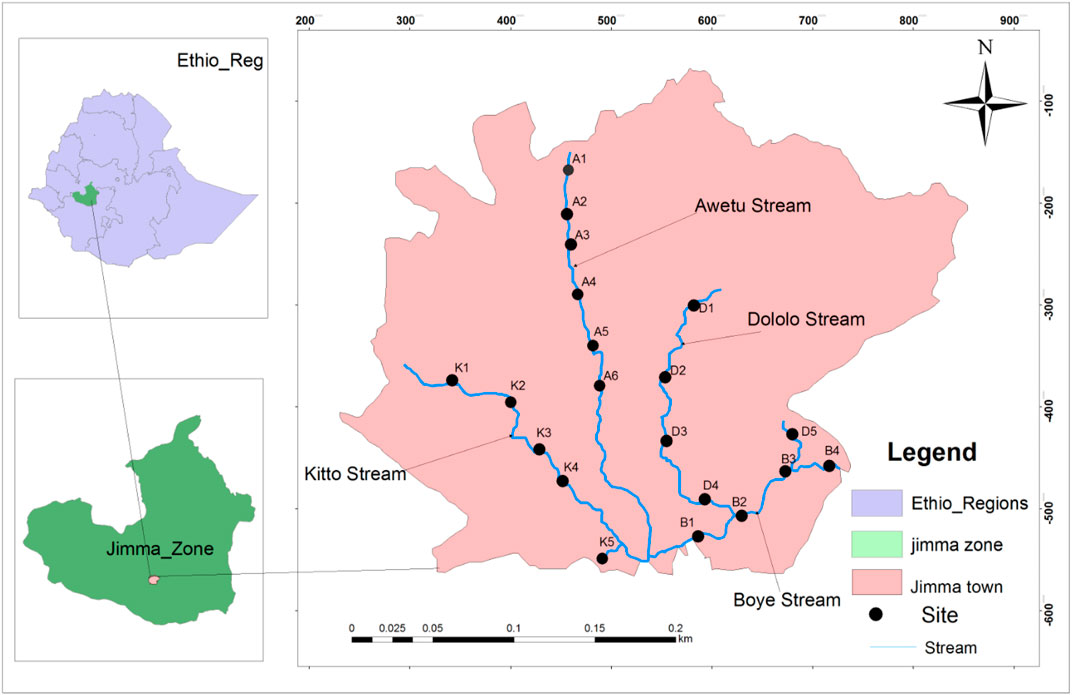
The article investigates heavy metal contamination in sediments of streams within the Awetu watershed in southwestern Ethiopia, driven largely by anthropogenic activities, including industrial discharges and urban runoff. It highlights the increasing threat of heavy metals, which can negatively impact aquatic ecosystems and public health through bioaccumulation in food chains.

Sediment samples were collected from four streams—Awetu, Dololo, Kito, and Boye—revealing concentrations of metals such as arsenic (As), cadmium (Cd), chromium (Cr), lead (Pb), and mercury (Hg) exceeding permissible limits set by global standards. The study employed contamination indices, including the Geo-Accumulation Index (Igeo), Contamination Factor (CF), and Pollution Load Index (PLI), to assess contamination levels. Results showed that sediments were notably polluted, especially in areas with intensive human activities like garages and agricultural runoff.

Statistical analyses indicated significant variability in heavy metal concentrations among different sampling locations, with pollution highest in Dololo stream due to its proximity to urban waste sources. The article emphasizes the pressing need for effective waste management practices in cities to mitigate heavy metal pollution and protect aquatic environments. Recommendations for future research include monitoring seasonal variations in metal concentrations to further understand contamination dynamics.

Overall, the findings unveil alarming levels of sediment pollution, necessitating immediate action to prevent further deterioration of water quality and ecosystem health in the region.

Source link

Awetu Ethiopia Heavy Metal Pollution Sediments Southwestern Watershed
Share. Facebook Twitter Pinterest LinkedIn Tumblr Email
Previous ArticleAre Natural Disasters on the Rise?
Next Article Factors Shaping Human Settlements and Ecosystems in the Upper Minjiang Watershed, China
leebenda
Terrain News
  • Website

Related Posts

Volunteers Transform Prairie Day at Jennings Environmental Education Center into a Success

April 15, 2026

Hydrologic Insights from Conductive Topsoils in Ecuador’s Alpine Catchment

April 13, 2026

Exploring Pathogenic Bacteria Dynamics in the Yangtze River Basin

April 12, 2026
Top Posts

Steamboat Secures $5 Million for River Revitalization

January 25, 202520 Views

Harnessing Machine Learning to Enhance Extreme Weather Alerts

January 8, 202519 Views

Boosting Carbon Storage: Maximizing Terrestrial Vegetation through Smart Land Management

February 1, 202516 Views
Stay In Touch
  • Facebook
  • YouTube
  • TikTok
  • WhatsApp
  • Twitter
  • Instagram
Most Popular

Steamboat Secures $5 Million for River Revitalization

January 25, 202520 Views

Harnessing Machine Learning to Enhance Extreme Weather Alerts

January 8, 202519 Views

Boosting Carbon Storage: Maximizing Terrestrial Vegetation through Smart Land Management

February 1, 202516 Views
Don't Miss

Volunteers Transform Prairie Day at Jennings Environmental Education Center into a Success

$6.5 Million Secured for Wildlife Habitat Restoration in 2026 Conservation Permits

Hydrologic Insights from Conductive Topsoils in Ecuador’s Alpine Catchment

Popular This Week

Collaboration for a Greener Future: Protecting the Paint Rock River

Wildfire Protection Grants Awarded to Lycoming and Sullivan County Fire Companies

Hydrologic Insights from Conductive Topsoils in Ecuador’s Alpine Catchment

© 2026 Terrain News. All Rights Reserved.
  • About Us
  • Privacy Policy
  • Terms and Conditions
  • Disclaimer

Type above and press Enter to search. Press Esc to cancel.