

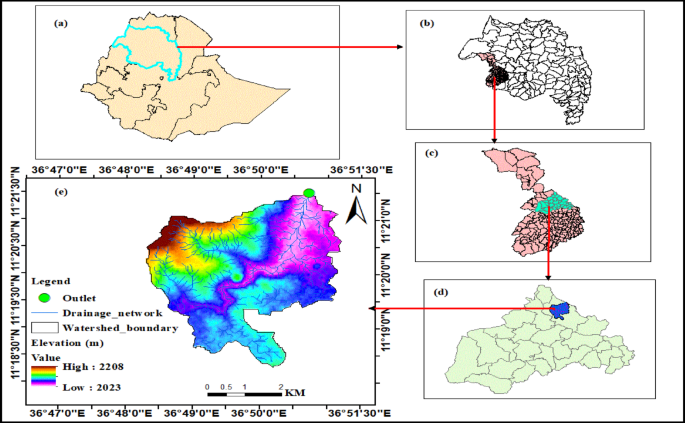
The article discusses an analysis of morphometric parameters in a watershed, utilizing Digital Elevation Models (DEM), remote sensing, and ArcGIS to evaluate surface development and soil erosion risks. It categorizes morphometric parameters into four types: linear, areal, shape, and relief, to identify areas vulnerable to soil erosion—crucial for effective mitigation strategies.
Linear Parameters: This involves stream characteristics like order, number, length, and bifurcation ratio. Higher linear parameter values indicate increased erosion risk and reflect the watershed’s morphology. The study used Strahler’s method for stream ordering, revealing various micro-watersheds of different stream orders.
Areal Parameters: Parameters such as drainage density (Dd), stream frequency (Fs), and drainage texture (Dt) were analyzed to highlight erosion risks. High values in these metrics correlate with greater runoff potential and increased erosion.
Shape Parameters: This section discusses geometric features (e.g., form factor, elongation ratio) with inversely proportional relationships to soil erosion. For instance, elongated shapes are more susceptible to erosion due to increased surface runoff.
Relief Parameters: These include elevation and ruggedness, which directly relate to erosion potential. Higher relief indicates increased susceptibility to erosion and less infiltration.
The article emphasizes that a multi-faceted approach to watershed prioritization enhances the accuracy of identifying erosion-prone areas. The weighted sum priority (WSP) method helped rank watersheds according to their erosion risk, revealing that approximately 78% of the studied area faces a very high risk of soil erosion.
The findings suggest urgent implementation of soil and water conservation practices, including terraces and reforestation, targeting high-risk micro-watersheds to mitigate erosion effectively. These strategies are crucial for sustainable management of the Kiltie watershed and offer a framework adaptable for other regions facing similar challenges.
