


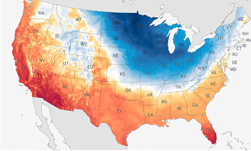
Rice University engineers developed a deep learning-based system to forecast heat waves and cold spells with 85% accuracy up to five days in advance. Co-authored by Pedram Hassanzadeh, Ashesh Chattopadhyay, and Ebrahim Nabizadeh, the study published in the American Geophysical Union’s Journal of Advances in Modeling Earth Systems identifies abnormal jet stream behaviors as indicators of these extreme weather events.
Using NVIDIA P100 GPUs, they trained their models on historical weather data from 1920 to 2005. They approached forecasting as a pattern recognition problem by employing both convolutional neural networks (CNN) and capsule neural networks (CapsNet), the latter of which is better at understanding spatial relationships critical to weather evolution.
The researchers aim for their system to provide early warnings for extreme weather, complementing traditional numerical weather predictions (NWP). They believe it could serve as a low-cost guide to optimize NWP resources focused on impending extreme events.
Source link
